
Reviewed · PALERMO HISTORIC CENTER WALKING TOURS
Discover the Charm of Palermo: A 3-Hour UNESCO Sites Walking Tour
Palermo’s UNESCO story runs on foot. In just 3 hours, this walk strings together baroque and Norman-Arabic architecture with clear explanations from a licensed English guide, so you understand what you’re seeing instead of just snapping photos. I especially like the way the route builds a sense of how Palermo layers cultures over time, and the fact that you end with a typical Sicilian treat, cannolo or granita. One consideration: the Palatine Chapel mosaics get attention, but the tour is designed around stops outside, so if you want a long, inside look at the chapel itself, you may need extra time or a separate visit.
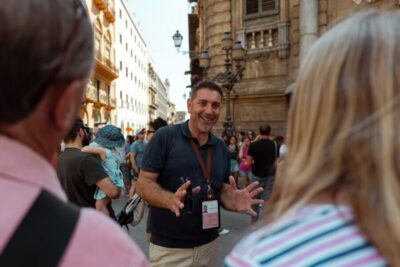
This tour feels like good “first-day” planning because you hit major sights in a compact loop and you get an actual Cathedral entrance (included), not just exterior views. The group stays small, with a maximum of 20 people, and you’ll use a mobile ticket at the start. If you want a slower pace with lots of hanging around, you might find the short stop times a bit tight, since the route moves.
In This Review
- Key Highlights You’ll Feel Immediately
- Why Palermo UNESCO Feels So Close in 3 Hours
- Teatro Massimo to Galleria delle Vittorie: Culture Meets Commerce
- San Domenico and the Piazza Markets: Churches and Street Life
- Martorana, the Descent of the Judges, and Palermo as a Power Map
- Piazza Pretoria and Quattro Canti: The City Center’s Stage Set
- Cattedrale di Palermo: Norman Layers and Arabic Details You Can See
- Villa Bonanno and Palazzo dei Normanni: Mosaics in the Background
- Food and Practical Tips for a Smooth Walk
- Should You Book This Palermo UNESCO Walking Tour?
- FAQ
- How long is the Palermo UNESCO sites walking tour?
- What does the tour cost, and what’s included with the price?
- Is the tour in English?
- Do I need a paper ticket?
- Are any admissions included besides the Cathedral?
- How many people are in the group?
- FAQ
- Is free cancellation available?
- Does the tour run in bad weather?
- Where does the tour start?
- Where does the tour end?
- Are hotel pick-up and drop-off included?
- Are pets allowed on the tour?
Key Highlights You’ll Feel Immediately
- Small-group focus (max 20) that keeps the tour from feeling like a conveyor belt
- Cathedral entry included, which is where Palermo’s Norman layers become really tangible
- Real city texture in open-air markets and street junctions, not only museum-style stops
- Guide storytelling that connects power and architecture, including the Descent of the Judges
- Sicilian finish with cannolo or granita, built into the experience rather than tacked on
Why Palermo UNESCO Feels So Close in 3 Hours
Palermo can feel like a big, noisy puzzle. This tour helps you solve it fast by focusing on a tight slice of the historic center where UNESCO-listed and UNESCO-relevant architecture sits close together. The format matters: you’re walking, stopping often, and getting explanations in the places where the details actually exist.
You also get two kinds of payoff. First is the visual one: you’ll see major monuments from Piazza Pretoria and Quattro Canti down to the Cattedrale di Palermo and the Palazzo dei Normanni complex. Second is the meaning one. Palermo’s look comes from repeated waves of rule and culture, and your guide’s job is to connect those waves to what’s carved, mosaicked, or repurposed.
It’s also a practical length. Three hours is long enough to get oriented and learn the big story, but short enough that you still have energy to explore afterward on your own. And with a max group size of 20, you should be able to ask questions without waiting forever for attention.
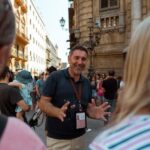
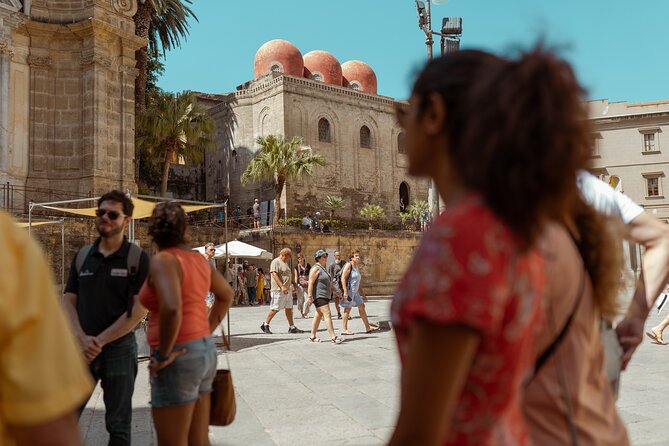
More of the old centre on foot, from the Quattro Canti to the markets.
Teatro Massimo to Galleria delle Vittorie: Culture Meets Commerce
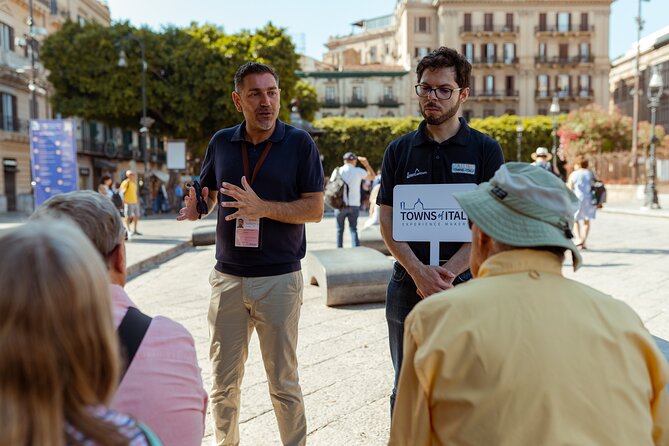
You start at Via Volturno, and the early minutes matter because they set the tone: Palermo isn’t only cathedrals. It’s also opera houses, shopping structures, and everyday street life.
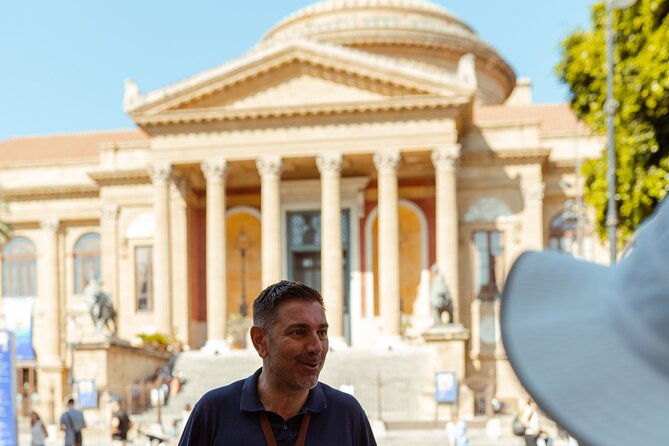
Teatro Massimo is your first architectural anchor. This opera house, dedicated to King Victor Emanuel II, is the biggest in Italy and was among the largest in Europe when it opened. What stands out in the story is the emphasis on acoustics. You don’t need to be an opera person to appreciate why an opera house that size gets treated like a civic symbol.
Right after, the tour pivots toward Galleria delle Vittorie, a five-story structure that was meant as a commercial mall. The building has deteriorated over the decades, and restoration efforts have been attempted. That stop is a subtle reminder that cities don’t stay still. What you see today is the result of ongoing change, not a time capsule.
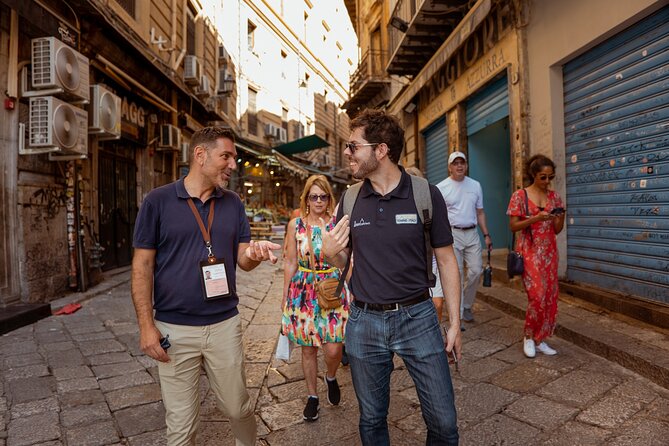
Then you cross into Via Bandiera, where you’ll get that market feel. This is where the tour earns its “beyond guidebooks” reputation. You’re not only learning the formal monuments; you’re learning the city’s rhythm—where people meet, browse, and eat. It also helps you understand why Palermo’s historic core works as a living neighborhood, not a themed district.
San Domenico and the Piazza Markets: Churches and Street Life
The route then turns religious and political at the same time with Chiesa di San Domenico. The church sits in its square in a way that makes it feel dominant, and it’s beloved for more than its architecture. It’s often described as a kind of Pantheon for the illustrious men of Sicily, and it also carries symbolic weight as a marker of resistance against the mafia.
From there, you move into the street markets, and that’s one of my favorite ways to experience Palermo. The tour threads between stops so you’re not just bouncing from one monument to another.
In Piazza Caracciolo, the market winds through alleys and adjacent streets, which is exactly the kind of urban design that keeps Palermo feeling like Palermo. It was formerly known as la Bucceria, tied to the French word for butcher shop, boucherie, which is a nice link to how markets shape neighborhood identity over time.
Next comes the Garraffo Fountain in Piazza Marina. Baroque fountains in Palermo aren’t just decoration. They mark important sightlines and reinforce the feel of the historic center as a stage for public life. You’ll also get the name recognition of Via Vittorio Emanuele (formerly tied to the ancient Cassaro route), which helps you orient yourself if you explore later.
If you’re wondering why the itinerary includes more than pure “church and palace” stops, it’s because Palermo’s power and wealth used to run through public spaces too. That idea shows up again around the Palermo Stock Exchange area in Palazzo delle Finanze.
Martorana, the Descent of the Judges, and Palermo as a Power Map
This section is where Palermo starts feeling like a story with cause and effect.
You’ll hear about the old Palermo Stock Exchange, which operated until 1997 when institutions were unified into one Italian stock exchange. Trading opened in 1845, and the exchange was described as the most important in Sicily. The tour also places it in context: Palermo wasn’t the only game in town, since other Sicilian exchanges were active until the First World War, including Messina, Catania, and Agrigento.
Then you’ll walk through a street-name history lesson on the descent of the judges. Once called calata dei giudici, this route takes its name from the Judges of the Praetorian Court who lived there in the monastery of S. Caterina. The tour explains how the judges were selected and the job structure for civil and criminal cases, which gives the city’s geography a legal backbone. It’s the kind of detail that makes you look at streets differently afterward—like they’re not random paths but records of how society worked.
After that, you reach Santa Maria dell’Ammiraglio, known as La Martorana. This church is central to why Palermo feels like an architectural hybrid. It was built between 1143 and 1185 by George of Antioch, a Greek admiral, and it’s associated with Greek-Byzantine clergy who still officiate in ancient Greek or Albanian. If you care about continuity of language and ritual—not just building styles—this is a strong stop.
Piazza Pretoria and Quattro Canti: The City Center’s Stage Set
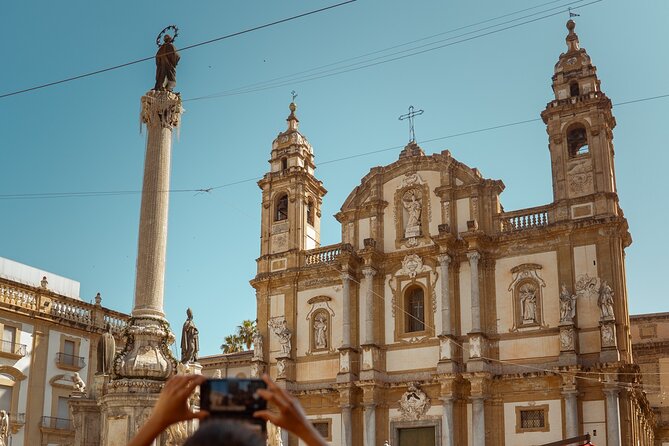
Then the tour lands in the absolute photo-and-orientation zone: Piazza Pretoria and Quattro Canti.
Piazza Pretoria is famous for its fountain and the odd, eye-catching concept of a garden with a very theatrical layout. The fountain was created for the garden of don Luigi de Toledo in Florence, and later the plot in Palermo went through pressure and negotiation before it was obtained in 1551. In 1584, the Palazzo di San Clemente was built nearby, shaping the square’s evolution. Even if you’re not a design nerd, the stop works because it shows how Palermo borrowed ideas and reworked them in its own setting.
A few steps away is Quattro Canti, also called Piazza Vigliena, one of the most spectacular junctions in the city. Four buildings define the corners, created between 1608 and 1620, with sculptures and decorative elements completed later, in 1663. You don’t need to time it perfectly for this stop. It’s one of those places where your brain clicks into “this is the center” mode immediately.
This is also why the tour helps you later. If you come back for a longer self-guided walk, Quattro Canti is the kind of landmark you can keep using as a compass point, not just a single viewpoint.
The Arab-Norman UNESCO trail through Palermo and Monreale.
Cattedrale di Palermo: Norman Layers and Arabic Details You Can See
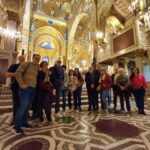
Now comes the included highlight: Cattedrale di Palermo.
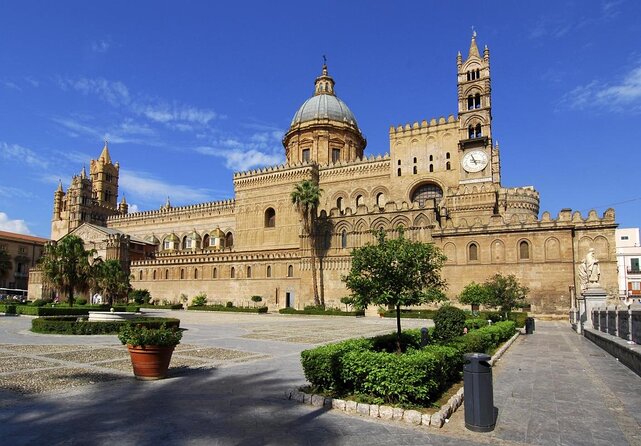
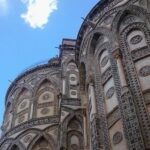
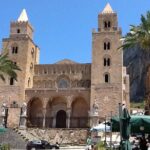
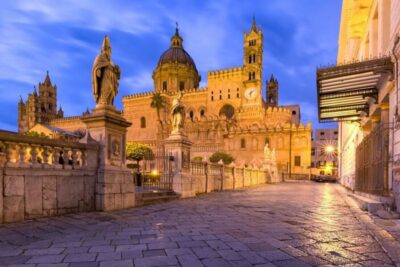
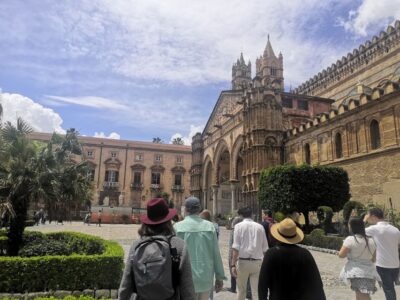
This cathedral is a treasure of Norman architecture in Sicily, and the key point is the building’s layered origins. It was built in 1184 by the Normans as a reconverted Christian church on the site of a Muslim mosque, which itself had been built over an earlier Christian basilica. That means you’re standing in a place where different communities re-used sacred ground rather than starting from blank paper.
Your guide also frames it as a moment of competition. The cathedral was built to surpass the Cathedral of Monreale in beauty, so you can expect strong “overachievement” instincts in the design choices that survived.
Inside and out, you’ll notice stratification: Gothic and medieval elements, Arabic influence, and even neoclassical layers. One detail that people love is the mention of an Arabic text: an actual passage from the Koran engraved on a column. Even if you’re not fluent in the language, it helps you understand how Palermo’s identity isn’t just a slogan. It’s carved into stone.
Practical note: plan to slow down here. The cathedral entrance is included, and this is your best chance during the tour to actually absorb what makes the Norman-Arabic style specific to Sicily, not generic “Norman-era” decoration.
Villa Bonanno and Palazzo dei Normanni: Mosaics in the Background
After the cathedral, the tour shifts from inside grandeur to what’s sometimes harder to spot: the surrounding spaces that quietly hold clues.
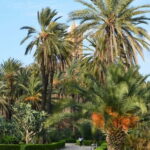
Villa Bonanno is an always-open garden in Victory Square, behind the Palazzo dei Normanni. It’s planted with palm trees, and there are statues and busts of famous people of Palermo. But the stop’s deeper payoff is what’s in the ground: the remains of Roman patrician houses with mosaics, including mosaics of the seasons and Orpheus, which are now kept in the National Archaeological Museum.
This is the kind of stop that works even if you’re not chasing museums. A garden can be a museum without walls, if the guide points out what used to be there.
Nearby, you’ll also encounter the fountain and its monument to Philip V. The tour notes that it seems the fountain was designed in 1661 by Carlo d’Aprile, with participation from Serpotta, which gives you a name trail to follow if you’re the type who likes to research later.
Finally, the route reaches the big signature building complex: Palazzo dei Normanni (Royal Palace), which connects to the Palatine Chapel. The Palatine Chapel is tied to Arab-Norman art and has been recognized as a World Heritage site since 2015. On this tour, you focus on learning from what you can see from outside, plus understanding why the chapel matters.
You’ll also hear about the Torre Pisana, which houses the Palermo Astronomical Observatory and the Specola Museum, plus the fact that temporary exhibitions can happen in halls like Sale del Duca di Montalto.
Food and Practical Tips for a Smooth Walk
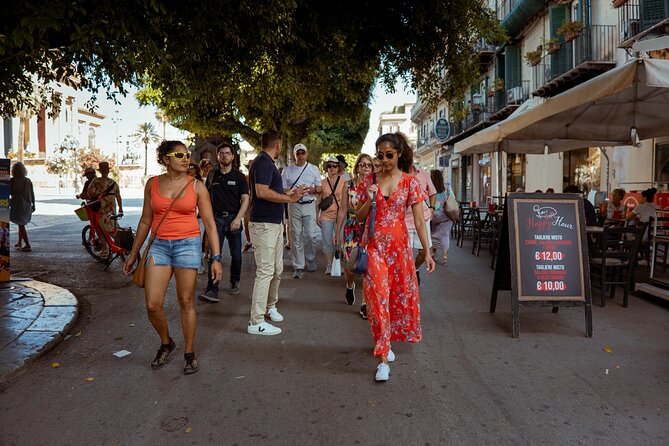
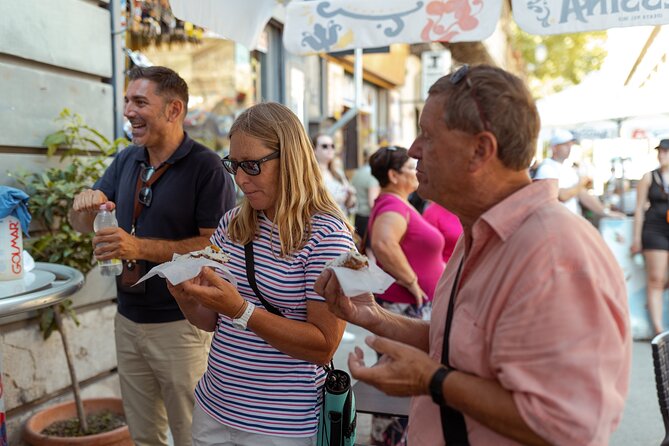
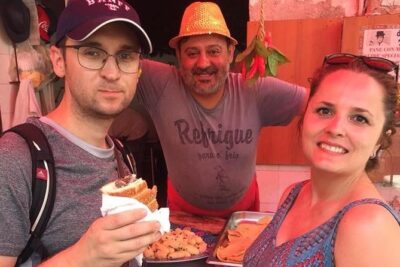
This tour includes a typical Sicilian treat at the end, either cannolo or granita. I like this style of food stop because it feels earned. You’ve spent hours learning the city’s architecture and street life, and then you get something local that fits right into the atmosphere.
Two more practical points make the experience easier:
- You’ll use a mobile ticket, which simplifies check-in.
- The walk is designed for real streets, not indoor pacing, and it runs regardless of weather. That means you should bring the usual Palermo gear: a light rain layer if the forecast looks sketchy, and comfortable shoes because historic centers can be uneven underfoot.
Group size also affects your day. With a maximum of 20 people, it’s easier to hear explanations and keep the pace from turning into chaos at every corner. If you want a tour that helps you come back later with better direction, this one does that job. If you want a tour that replaces museum time, you might feel the limits, especially around the Palatine Chapel focus.
Should You Book This Palermo UNESCO Walking Tour?
Yes, if you want a strong introduction to Palermo’s UNESCO-area feel without spending an entire day jumping between distant sights. It’s good value because it bundles a licensed English guide, Cathedral entry, and a Sicilian treat into one compact loop. You also get a mix of monuments and living neighborhoods, which is how Palermo stays interesting instead of turning into a checklist.
Book it sooner rather than later if you’re traveling in peak periods, since it’s commonly booked about a month in advance. And if you’re dreaming specifically about extended time inside the Palatine Chapel mosaics, know that this tour’s angle is more about context from outside.
FAQ
How long is the Palermo UNESCO sites walking tour?
It lasts about 3 hours.
What does the tour cost, and what’s included with the price?
The price is $31.88 per person. Included items are a licensed English-speaking guide, the walking tour, entrance to the Cathedral, and a typical Sicilian cannolo or granita.
Is the tour in English?
Yes, it is offered in English.
Do I need a paper ticket?
No. You’ll use a mobile ticket.
Are any admissions included besides the Cathedral?
The Cathedral entrance is included. Other stops are described as from outside or without admission tickets listed as included.
How many people are in the group?
The tour has a maximum of 20 travelers.
FAQ
Is free cancellation available?
Yes. You can cancel up to 24 hours in advance for a full refund.
Does the tour run in bad weather?
Yes. The tour takes place regardless of the weather.
Where does the tour start?
The tour starts at Via Volturno, 44, 90138 Palermo PA, Italy.
Where does the tour end?
The tour ends back at the meeting point (Via Volturno, 44).
Are hotel pick-up and drop-off included?
No. Hotel pick-up and drop-off are not included.
Are pets allowed on the tour?
No, pets are not permitted on the tours.
More Tour Reviews in Palermo
More Arab-Norman Heritage Days
More Palermo Old Town Walks
After something else? More tours and day trips around Palermo and western Sicily




Palermo Historic Center Walking Tours, compared.
 ★ 4.8NO Mafia Walking TourFrom $402,431 reviews
 ★ 5.0Palermo Original Street Food Walking Tour by StreatyFrom $832,105 reviews
 ★ 4.9Street Food and History Walking TourFrom $541,294 reviews
 ★ 5.0Palermo No Mafia walking tour: discover the Anti-mafia culture in SicilyFrom $391,011 reviews
 ★ 4.7Private Custom Walking Tour with Local GuideFrom $53661 reviews
 ★ 4.9Street Food Walking Tour with Local Guide & TastingFrom $52632 reviews
 ★ 5.0Palermo Walking Tour and Street FoodFrom $48617 reviews
 ★ 4.8UNESCO World Heritage Sites Guided Walking TourFrom $41548 reviews
Browse the lists this tour appears in